
Guillaume Apollinaire
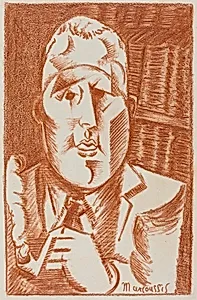
Medium
red crayon on wove paper
Dimensions
overall: 28.3 x 19 cm (11 1/8 x 7 1/2 in.)
Classification
Drawing
Department
CG-W
Museum
National Gallery of Art, Washington, D.C.
Credit
Andrew W. Mellon Fund
Accession Number
1976.22.1
Rights
Public Domain
Art Historical Context
In the vibrant avant-garde circles of post-World War I Paris, Polish-French artist Louis Casimirislas Marcoussis captured the essence of poet and critic Guillaume Apollinaire in intimate 1921 drawing. Executed in vivid red crayon on wove, the modest 28.3 x 19 cm sheet (11 1/8 x 7 1/2 in.) exemplifiesoussis's shift from early Cubist experiments toward more fluid, personal expressions. Apollinaire, who died in 1918 from the Spanish flu pandemic, was a towering figure in modernism—coining the term "Surrealism" and championing Cubism through his writings, making this posthumous portrait a poignant tribute. Marcoussis, a close associate of Pablo Picasso and other Cubists, favored dynamic lines and bold color in his works, and the red crayon here lends a warm, immediate energy to the composition. Wove paper, with its smooth texture, was ideal for precise crayon strokes, allowing for subtle modeling and texture. Acquired through the Andrew W. Mellon Fund for the National Gallery of Art's collection (Department CG-W), this drawing highlights the interplay between visual art and literature in early 20th-century Paris. As a classified drawing, it offers visitors a glimpse into the human side of revolutionary movements, evoking the camaraderie of artists and poets who reshaped culture amid turmoil. A testament to enduring friendships, it invites reflection on Apollinaire's legacy.