
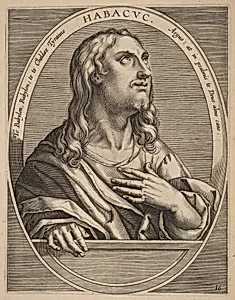
Habachuch
published 1613
Medium
engraving on laid paper
Dimensions
plate: 17.7 x 13.9 cm (6 15/16 x 5 1/2 in.) sheet: 24.3 x 19 cm (9 9/16 x 7 1/2 in.)
Classification
Department
CG-E
Museum
National Gallery of Art, Washington, D.C.
Credit
Ailsa Mellon Bruce Fund
Accession Number
1974.55.7.p
Rights
Public Domain
Art Historical Context
This engraving titled "Habachuch," created by Theodor Galle after a design by the Flemish artist Jan van der Straet and published in 1613, reflects the dynamic world of early seventeenth-century printmaking. Galle, working from Stradanus’s inventive compositions, translated the original drawing into a precise engraving on laid paper. Such reproductive prints played a vital role in disseminating images across Europe, allowing wider audiences to encounter subjects that might otherwise have remained in private collections or distant studios. Stradanus, active in both Antwerp and Florence, frequently supplied designs for series that combined artistic skill with scholarly or devotional themes. The modest plate size—just under seven by five and a half inches—made the work suitable for inclusion in books or albums, underscoring how prints functioned as portable carriers of iconography and style during the period. The crisp lines and tonal contrasts typical of engraving enabled fine detail and durability, qualities that helped establish prints as respected works of art in their own right. Acquired through the Ailsa Mellon Bruce Fund, this sheet now preserves a glimpse into the collaborative networks that shaped visual culture in the Baroque era.