
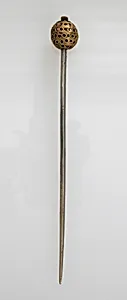
Hairpin
Unknown Artist
500–700
Medium
Silver, gold
Dimensions
Overall: 5 11/16 x 9/16 in. (14.5 x 1.5 cm) knop: 9/16 in. (1.5 cm)
Classification
Metalwork-Silver
Culture
Frankish
Department
Medieval Art
Museum
Metropolitan Museum of Art, New York, NY
Credit
Gift of J. Pierpont Morgan, 1917
Accession Number
17.192.240
Rights
Public Domain
Art Historical Context
This exquisite Frankish hairpin, dating from 500–700 CE, exemplifies refined metalworking skills of the early Medieval period the Merovingian era Crafted from silver with gold accents, measures a slender 5 11/16 x 9/16 inches (14.5 x 1.5 cm overall), topped by a decorative knop just 9/16 inch (1.5 cm) wide. Such hairpins were essential personal adornments, often used by women of status to secure elaborate hairstyles, blending everyday utility with displays of wealth and craftsmanship. In Frankish culture, which dominated much of early medieval Europe under kings like Clovis and his successors, objects like this hairpin highlight the fusion of Roman artistic traditions with emerging Germanic styles. The use of precious metals—silver as the base, enhanced by gold—signaled social prestige, as these materials were laboriously sourced and worked. Artisans employed techniques like gilding or inlay to create subtle opulence, reflecting a society transitioning from late antiquity to the feudal world. A generous gift from J. Pierpont Morgan in 1917, this piece now graces the Metropolitan Museum of Art's Medieval Art collection. It invites us to imagine the daily lives of Frankish elites, where even a simple hairpin carried profound cultural weight as a marker of identity and refinement.