
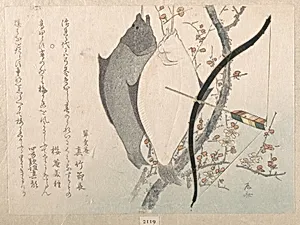
Halibuts and a Bow with Arrow Hanging on a Plum Tree
19th century
Medium
Woodblock print (surimono); ink and color on paper
Dimensions
5 7/16 x 7 3/8 in. (13.8 x 18.7 cm)
Classification
Prints
Culture & Period
Japan · Edo period (1615–1868)
Department
Asian Art
Museum
Metropolitan Museum of Art, New York, NY
Credit
H. O. Havemeyer Collection, Bequest of Mrs. H. O. Havemeyer, 1929
Accession Number
JP2119
Rights
Public Domain
Tags
Art Historical Context
In the tranquil world of Edo-period Japan (1615–1868), Ryūryūkyo Shinsai crafted this charming woodblock print titled *Halibuts and a Bow with Arrow Hanging on Plum Tree*. Created in the early 19th century, surimono—a luxurious, privately commissioned print often exchanged among poetry enthusiasts or for New Year's celebrations—measures a intimate 5 7/16 x 7 3/8 inches. Shinsai, a master of the ukiyo-e tradition, excelled in these bespoke works, blending meticulous ink lines with vibrant colors on paper to capture everyday motifs with poetic elegance. The composition playfully juxtaposes flat halibuts, a strung bow, and arrow dangling from a plum tree's branches, evoking a sense of whimsical harmony. Plum trees, blooming resiliently in late winter, symbolize perseverance and renewal in Japanese culture, while fish like halibuts often signified abundance. The bow and arrow add a dynamic martial touch, perhaps nodding to heroic tales or seasonal festivities. Surimono like this highlighted advanced printing techniques, including subtle gradations and precise registration, making them prized collector's items. Generously bequeathed to the Metropolitan Museum of Art through the H. O. Havemeyer Collection in 1929, this print offers a window into Japan's refined artistic culture, where nature, symbolism, and craftsmanship intertwined to delight the elite.
About the Artist
Ryūryūkyo Shinsai · 1799–1823
Ryūryūkyo Shinsai (柳々居辰斎), active from 1799 to 1823, was a prominent Japanese ukiyo-e printmaker based in Edo (modern Tokyo), renowned for his mastery of surimono—luxurious, privately commissioned woodblock prints produced for elite poetry circles and New Year's celebrations. He began his training under Tawaraya Sōri before becoming a student of the legendary Katsushika Hokusai, from whom he recei...