
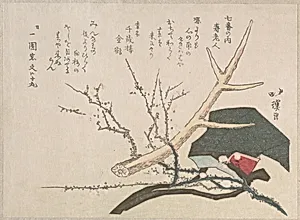
Hat, Deer-Horn and Plum Branch, Representing Jurōjin, the God of Life
19th century
Medium
Part of an album of woodblock prints (surimono); ink and color on paper
Dimensions
5 3/8 x 7 3/8 in. (13.7 x 18.7 cm)
Classification
Prints
Culture
Japan
Department
Asian Art
Museum
Metropolitan Museum of Art, New York, NY
Credit
H. O. Havemeyer Collection, Bequest of Mrs. H. O. Havemeyer, 1929
Accession Number
JP2390
Rights
Public Domain
Tags
Art Historical Context
This delightful woodblock print by Totoya Hokkei, 19th-century Japanese artist and pupil of the famed Katsushika Hokus, is part of a luxurious *surimono* album. Titled *Hat, Deerorn and Plum Branch,ing Jurōjin, God of Life*, it a compact 5 3/8 x 7 3/8 inches and showcases Hokkei's mastery of ink and color on paper. *Surimono*—privately commissioned prints often for New Year's celebrations or poetry gatherings—elevated ukiyo-e art with refined techniques like embossing, mica dusting, and vibrant pigments, making them treasured keepsakes for Japan's literati. The image cleverly symbolizes Jurōjin, one of the Seven Lucky Gods (*Shichifukujin*) in Japanese folklore, embodying longevity and wisdom. His attributes—a deer antler (evoking his loyal deer companion), a plum branch (plums bloom early, signifying enduring life), and a distinctive hat—convey prosperity and good fortune. These motifs blend Shinto and Buddhist traditions, reflecting Edo-period (1603–1868) fascination with auspicious icons amid everyday life. Hokkei's whimsical yet precise style captures the playful spirit of *surimono*, blending humor with spiritual depth. Acquired through the H.O. Havemeyer Collection and now in the Metropolitan Museum of Art's Asian Art department, this print invites visitors to ponder how art wove divine blessings into intimate, celebratory moments.
About the Artist
Totoya Hokkei · 1780–1850
Totoya Hokkei (魚屋 北渓, 1780–1850), born Iwakubo Tatsuyuki in Edo (modern Tokyo), began his life as a humble fishmonger in the Yotsuya Samegahashi district, a trade reflected in his art name "Totoya," meaning fish shop. He transitioned to art through rigorous training, first studying under Kanō Yōsen'in Korenobu, head of the Kobikichō branch of the prestigious Kanō school, where he honed landscape p...