
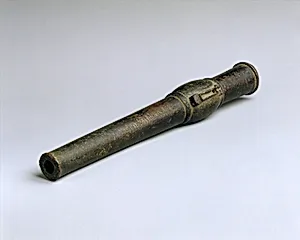
Hand Cannon (Chong)
Unknown Artist
dated 1424
Medium
Bronze
Dimensions
L. 14 1/16 in. (35.7 cm); Cal. .59 in. (15 mm); Wt. 5 lb. 0.2 oz. (2273.6 g)
Classification
Firearms
Culture
Chinese
Department
Arms and Armor
Museum
Metropolitan Museum of Art, New York, NY
Credit
Purchase, Arthur Ochs Sulzberger Gift, 2002
Accession Number
2002.560
Rights
Public Domain
Tags
Art Historical Context
Step into the riveting world of early firearms with this *Hand Cannon (Chong)*, a bronze masterpiece dated 1424 from Ming Dynasty China. Measuring just 14 inches long and weighing over 5 pounds, this portable weapon was designed for handheld use, bridging the gap between ancient fire lances and modern guns. Its .59-inch caliber made it a formidable tool on the battlefield, reflecting China's pioneering role in gunpowder technology since the 9th century. Crafted in bronze—a durable alloy prized for its casting properties—this cannon exemplifies advanced Chinese metallurgy. The smooth bore and sturdy construction allowed for reliable powder charges, marking a leap in military innovation during the Yongle era, when the Ming empire expanded its influence through superior arms. As one of the earliest surviving hand cannons, it highlights how firearms democratized warfare, shifting power from elite archers to foot soldiers. Housed in the Metropolitan Museum of Art's Arms and Armor department, this piece invites us to ponder the dual legacy of ingenuity and conflict. Acquired through the Arthur Ochs Sulzberger Gift in 2002, it stands as a testament to China's enduring contributions to global martial history.