
Head and Shoulders of Figure
1919-1920
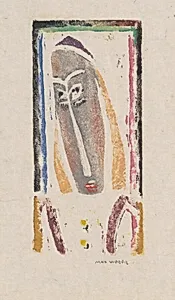
Medium
color woodcut on laid paper
Dimensions
image: 10.8 x 5.1 cm (4 1/4 x 2 in.) sheet: 21.6 x 15.6 cm (8 1/2 x 6 1/8 in.)
Classification
Department
CG-W
Museum
National Gallery of Art, Washington, D.C.
Credit
Gift of Jack and Margrit Vanderryn
Accession Number
2015.114.15
Rights
Public Domain
Art Historical Context
Max Weber's *Head and Shoulders of Figure* (1919-1920) is a striking example of early 20th-century modernism in printmaking. Created as a color woodcut on laid paper, this intimate work measures just 10.8 x 5.1 cm for the image, inviting close contemplation. Weber, a Russian-born American artist (1881–1961), was ablazer in bringing European avant-garde styles like Cubism and Synchromism to the States. By the late 1910s, after World War I, he turned to printmaking, experimenting with the woodcut's bold, carved lines and layered colors to distill human form into abstracted essence. The technique of color woodcut—requiring separate blocks inked in hues like reds, blues, and blacks—highlights Weber's mastery of reduction and rhythm. Here, the figure's head and shoulders emerge with angular facets and vibrant contrasts, echoing his Cubist influences while evoking emotional depth. This period marked Weber's shift toward more personal, figurative expressions amid America's burgeoning modern art scene. Generously gifted to the National Gallery of Art by Jack and Margrit Vanderryn, this print exemplifies the medium's accessibility and durability. Its small scale belies its cultural weight, bridging fine art and everyday appreciation in the Department of Modern Prints. Visitors will appreciate how Weber captures humanity's quiet intensity through such modest means.
About the Artist
Max Weber · 1881–1961
Max Weber (1881–1961), born in Białystok in the Russian Empire (now Poland) to Orthodox Jewish parents, immigrated to Brooklyn, New York, at age ten with his family, joining his tailor father.) There, he pursued art studies at the Pratt Institute under Arthur Wesley Dow, an innovative teacher who emphasized expression and form over traditional narrative, drawing from Japanese art and Paul Gauguin....