
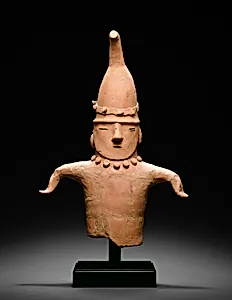
Head and Torso of a Dancing Figure
5th–7th century
Medium
Earthenware
Dimensions
48.3 × 35 × 15.8 cm (19 1/16 × 13 13/16 × 6 1/4 in.)
Classification
earthenware
Department
Arts of Asia
Museum
Art Institute of Chicago
Accession Number
73800
Rights
Public Domain
About this artwork
Haniwa (literally “clay rings”) were made as funerary sculptures for Japanese nobility. Unlike Chinese tomb figures, which were buried with the deceased in underground chambers, haniwa were placed on the surface of earthen grave mounds. Rows of haniwa, partially submerged in the soil for stability, outlined the sacred contours of a burial site or were set up at its front. This head and torso of a male figure appears to be dancing, perhaps a common event at funeral ceremonies.
About the Artist
Unknown
The artist designated as "Unknown" in our virtual museum's collection exemplifies a poignant chapter in art history: creators whose identities have faded into obscurity despite the enduring power of their work. With only one known artwork attributed to them in our holdings, this figure represents countless anonymous hands that shaped visual culture across centuries. Museums worldwide, including th...