
Head of a Bearded Elder
1768
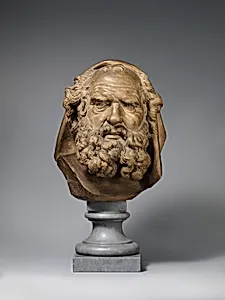
Medium
Terracotta on a bleu turquin marble socle
Dimensions
without socle, confirmed: 14 1/4 × 12 1/8 × 9 1/2 in. (36.2 × 30.8 × 24.1 cm) with socle, confirmed: 21 1/2 × 12 1/8 × 9 1/2 in., 43.1 lb. (54.6 × 30.8 × 24.1 cm, 19.6 kg)
Classification
Sculpture
Culture
French, probably Paris
Department
European Sculpture and Decorative Arts
Museum
Metropolitan Museum of Art, New York, NY
Credit
Purchase, Lila Acheson Wallace Gift, 2003
Accession Number
2003.25
Rights
Public Domain
Tags
Art Historical Context
Augustin Pajou's *Head of a Bearded* (1768) is a captivating terracotta bust that exemplifies the neoclassical precision and humanism of one of France's foremost 18th-century sculpt. Pajou, a Prix de Rome winner who served the royal court under Louis XV, crafted this introspective portrait from Paris, likely as a study or modello for larger marble works. The elder's weathered features—deep-set eyes, furrowed brow, and flowing beard—convey wisdom and gravitas, inviting viewers to ponder his untold story. Terracotta, a favored medium for sculptors' preliminary models, allowed Pajou to achieve a remarkable tactility and immediacy. The warm, earthy clay captures subtle surface textures, from the elder's tousled hair to the fine wrinkles of age, showcasing Pajou's mastery of form and expression. Mounted on an elegant bleu turquin marble socle, the 21½-inch-high sculpture gains a pedestal-like poise, blending raw modeling with refined finish—a nod to the era's transition from Rococo exuberance to neoclassical restraint. Acquired by The Metropolitan Museum of Art in 2003, this piece highlights French portraiture's psychological depth, bridging antiquity's ideals with Enlightenment-era realism. It's a testament to Pajou's enduring influence on European sculpture.
About the Artist
Augustin Pajou · 1730–1809
Augustin Pajou (1730–1809) was one of the foremost French sculptors of the second half of the eighteenth century, whose long and distinguished career bridged the Rococo grace of the Ancien Régime and the more sober classicizing spirit that emerged in the revolutionary and Napoleonic periods. Born in Paris into a family with artistic connections — his father was an ornamental sculptor — Pajou showe...