
Head of Dionysus
1783
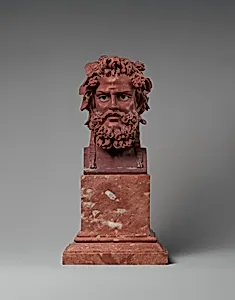
Medium
Bust: red griotte marble; eyes: inlaid with white marble with black marble pupils; base: fleur-de-pêcher marble
Dimensions
Overall (with base): 12 3/8 × 6 1/8 in. (31.4 × 15.6 cm); Overall (without base): 7 3/8 × 3 3/4 × 3 in. (18.7 × 9.5 × 7.6 cm)
Classification
Sculpture
Culture
Italian
Department
European Sculpture and Decorative Arts
Museum
Metropolitan Museum of Art, New York, NY
Credit
Gift of J. Pierpont Morgan, 1917
Accession Number
17.190.816
Rights
Public Domain
Tags
Art Historical Context
This striking marble bust of Dionysus, created by the Italian sculptor and goldsmith Luigi Valadier in 1783, captures the essence of the ancient Greek god of wine, fertility, and theatrical ecstasy. Valadier, working in Rome during the height of the Neoclassical movement, drew inspiration from classical antiquity to revive the god’s image for an 18th-century audience. The compact scale—measuring just over seven inches without its base—suggests it was designed as an intimate collector’s piece rather than a monumental public work. The sculpture’s materials highlight Valadier’s masterful technique and attention to lifelike detail. The head is carved from rich red griotte marble, while the eyes are inlaid with white marble and black pupils, lending an animated, almost piercing gaze. Set upon a contrasting fleur-de-pêcher marble base, the piece demonstrates the artist’s skill in combining colored stones to evoke both luxury and classical authenticity. Now part of the Metropolitan Museum of Art’s European Sculpture and Decorative Arts collection, this work entered the museum through the generosity of J. Pierpont Morgan in 1917. It stands as a testament to Valadier’s ability to bridge ancient mythology with refined Enlightenment-era craftsmanship, inviting viewers to appreciate both the god’s timeless allure and the sculptor’s technical brilliance.
About the Artist
Luigi Valadier · 1726–1785
**Luigi Valadier (1726–1785)** was a leading Italian goldsmith, silversmith, jeweler, and sculptor active in eighteenth-century Rome. Born in Rome on February 26, 1726, he was the son of Andrea Valadier, a French-born silversmith who had settled in the city in 1714 and established a successful workshop on via del Babuino. Luigi trained and began his career in his father’s workshop, assuming its di...