
Head of a Bodhisattva
Kushan period, About 3rd/5th century
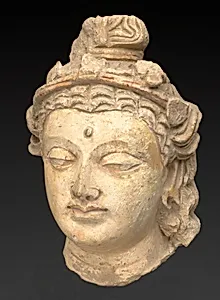
Medium
Stucco with traces of red pigment
Dimensions
20.4 × 13.5 × 10.8 cm (8 × 5 5/16 × 4 1/4 in.)
Classification
bust/head
Department
Arts of Asia
Museum
Art Institute of Chicago
Accession Number
8272
Rights
Public Domain
Art Historical Context
Behold the serene *Head of a Bodhisatt*, a captivating stucco sculpture from the Kushan period (circa 3rd–5th century CE), hailing from the ancient crossroads of Central Asia and India. Crafted during the height of the Kushan Empire this 20.4 cm tall bust embodies the compassionate ideal of a bodhisattva—an enlightened being in Mahayana Buddhism who postpones nirvana to aid. Its gentle expression and idealized features reflect the empire's role as a cultural bridge, fostering the spread of Buddhism along the Silk Road. The artwork's medium, stucco with faint traces of red pigment, highlights innovative techniques of the era. Stucco, a molded plaster composite, allowed artisans to achieve fine details like flowing hair, elongated earlobes symbolizing wisdom, and a subtle smile evoking inner peace. Once vividly painted, as suggested by the pigment remnants, such sculptures adorned monasteries and shrines, bringing spiritual narratives to life in three dimensions. Housed in the Art Institute of Chicago's Arts of Asia department, this piece exemplifies Gandharan art's fusion of Greco-Roman realism and Indian spirituality—a testament to Kushan patronage of Buddhism. It invites visitors to ponder the enduring message of empathy across millennia.
About the Artist
Unknown
The artist designated as "Unknown" in our virtual museum's collection exemplifies a poignant chapter in art history: creators whose identities have faded into obscurity despite the enduring power of their work. With only one known artwork attributed to them in our holdings, this figure represents countless anonymous hands that shaped visual culture across centuries. Museums worldwide, including th...