
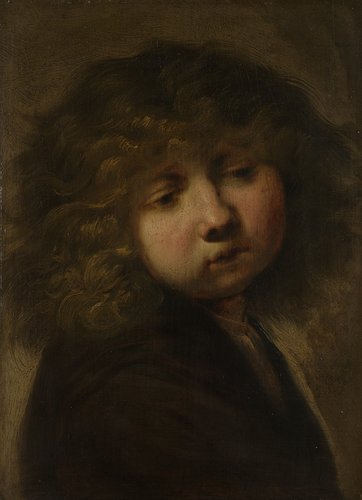
Head of a Boy
in or after 1643
Medium
oil on panel
Dimensions
5.5; 20; 27.5
Rights
Public Domain
About this artwork
inscriptie, rechtsonder: ‘Rembrandt geretucee[rd] … Liev[ens]’
Art Historical Context
**Head of a Boy** by Jan Lievens, created in or after 1643, invites visitors into the intimate world of Dutch Golden Age portraiture. This small oil on panel (27.5 × 20 cm) captures a boy's thoughtful gaze with remarkable tenderness, showcasing Lievens' skill in rendering youthful features and subtle expressions. A close contemporary and friend of Rembrandt—they shared a studio in Leiden as young artists—Lievens mastered dramatic lighting and textured brushwork, hallmarks of the era's innovative realism. What makes this work especially intriguing is the inscription in the lower right: *‘Rembrandt geretucee[rd] … Liev[ens]’*, indicating Rembrandt himself retouched the painting. This rare evidence of collaboration between two titans underscores their mutual influence during a pivotal time; by 1643, Lievens had traveled to England and Antwerp, absorbing Baroque influences that enriched his style. Such interventions highlight the fluid artistic exchanges in 17th-century Holland. Housed in the Rijksmuseum, this modest *tronie*—a character study prized for its emotional depth—exemplifies how Dutch masters elevated everyday subjects to universal truths, blending technical virtuosity with human insight. A gem for contemplating genius in dialogue.
About the Artist
Jan Lievens · 1607–1674
Jan Lievens (1607–1674) was born in Leiden and showed exceptional artistic promise from an early age, beginning his training with the local painter Joris van Schooten before traveling to Amsterdam around 1617 to study for two years under Pieter Lastman—the same teacher who would later instruct Rembrandt van Rijn. Lievens and Rembrandt, near-contemporaries born in the same city, subsequently shared...