
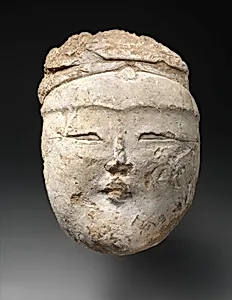
Head of a Central Asian Figure
Unknown Artist
12th–13th century
Medium
Gypsum plaster; modeled, carved
Dimensions
H. 6 7/8 in. (17.5 cm) W. 5 1/4 in. (13.3 cm) D. 3 5/8 in. (9.2 cm) Wt. 37.5 oz. (1063.2 g)
Classification
Stucco-Sculpture
Department
Islamic Art
Museum
Metropolitan Museum of Art, New York, NY
Credit
Purchase, Friends of Islamic Art Gifts, 2014
Accession Number
2014.529
Rights
Public Domain
Tags
Art Historical Context
This exquisite *Head of a Central Asian*, crafted in the 12th–13th century, captures the refined artistry of Islamic Central Asia during a vibrant era of cultural exchange along the Silk Road. Carved from gypsum plaster—a lightweight, versatile medium prized for its moldability—this small-scale stucco sculpture (just under 7 inches tall) exemplifies techniques of modeling and intricate carving. Such methods allowed artisans to achieve lifelike details in facial features, textures, and expressions, often adorning architectural elements like mihrabs or tomb decorations in mosques and madrasas. In the Islamic art tradition, figurative sculpture like this head is rare due to aniconic tendencies, making it a fascinating outlier from regions such as modern-day Uzbekistan or Afghanistan. It likely represents a local figure—perhaps a scholar, saint, or ancestor—reflecting the blend of Persian, Turkic, and Islamic influences before the Mongol invasions disrupted these centers. Its preservation offers a window into everyday devotional or commemorative practices. Acquired by the Metropolitan Museum of Art in 2014 through the Friends of Islamic Art, this piece invites visitors to ponder the human stories behind Central Asia's monumental architecture, where subtle, expressive details brought sacred spaces to life.