
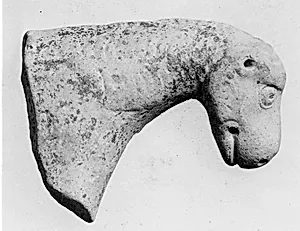
Head of a Horse
Unknown Artist
early 12th century
Medium
Earthenware
Dimensions
2 3/4 x 1 1/2 in. (7 x 3.8 cm)
Classification
Sculpture
Culture
Central Asia
Department
Asian Art
Museum
Metropolitan Museum of Art, New York, NY
Credit
Rogers Fund, 1930
Accession Number
30.32.59
Rights
Public Domain
Tags
Art Historical Context
Nestled in the Metropolitan Museum of Art's Asian collection, this delicate *Head of a Horse* a small earthenware sculpture Central Asia, crafted in the early 12th. Measuring just 2 3/4 x 1/2 inches, its modest scale belies its cultural resonance, likely part of a figurine or votive object. Earthenware, a low-fired clay medium, was prized in the region for its accessibility, allowing artisans to capture lifelike details through hand-modeling before firing. In 12th-century Central Asia—a crossroads of Silk Road trade, steppe cultures, and emerging Islamic influences—horses symbolized power, mobility, and survival. These swift steeds powered warriors, traders, and herders across vast landscapes, from the Kara-Khanid Khanate to pre-Mongol territories. This horse head, with its alert expression, evokes that vital equine heritage, perhaps serving as a talisman, toy, or ritual offering. Acquired through the Rogers Fund in 1930, this anonymous masterpiece highlights the ingenuity of Central Asian potters. Its survival offers a tangible glimpse into a world where art intertwined with daily life and mythology, inviting us to ponder the horse's enduring role in human history.