
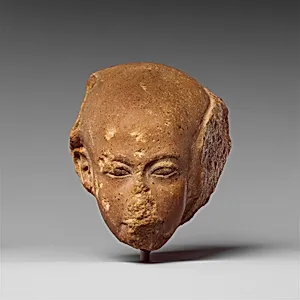
Head of a princess from a group statue
Unknown Artist
ca. 1352–1336 B.C.
Medium
Quartzite
Dimensions
H. 14 cm (5 1/2 in.); W. 12.4 cm (4 7/8 in.); D. 16.2 cm (6 3/8 in.)
Classification
Head, Amarna princess
Period
New Kingdom, Amarna Period
Department
Egyptian Art
Museum
Metropolitan Museum of Art, New York, NY
Credit
Purchase, Lila Acheson Wallace Gift, 2005
Accession Number
2005.363
Rights
Public Domain
Tags
Art Historical Context
This delicate quartzite head, carved around 1352–1336 B.C. during Egypt’s New Kingdom Amarna Period, once formed part of a larger group statue depicting a royal family. Created in Dynasty 18 under the reign of Akhenaten, it reflects the era’s remarkable artistic shift toward more naturalistic and expressive portrayals of the human form. The fragment’s soft modeling and gentle tilt of the neck suggest the intimate, affectionate compositions typical of Amarna sculpture, where princesses were frequently shown alongside their parents in scenes of daily life and devotion. Quartzite, a hard and luminous stone prized by Egyptian sculptors, allowed the artist to achieve subtle transitions of light across the face. Though the princess’s identity remains unknown, her youthful features and the work’s refined finish speak to the high status of royal children at court. Such group statues were often placed in temples or palaces, emphasizing the divine nature of the royal family during a time of religious transformation centered on the sun god Aten. Acquired by the Metropolitan Museum of Art in 2005 through the Lila Acheson Wallace Gift, this small yet evocative piece offers visitors a tangible connection to one of ancient Egypt’s most innovative artistic moments.