
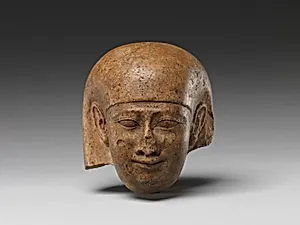
Head of an official
Unknown Artist
400–200 B.C.
Medium
Quartzite
Dimensions
H. 7.3 × W. 7.1 × D. 8.6 cm (2 7/8 × 2 13/16 × 3 3/8 in.)
Classification
Head
Period
Late Period–Early Ptolemaic Period
Department
Egyptian Art
Museum
Metropolitan Museum of Art, New York, NY
Credit
Theodore M. Davis Collection, Bequest of Theodore M. Davis, 1915
Accession Number
30.8.82
Rights
Public Domain
Tags
Art Historical Context
This finely carved quartzite head, titled *Head of an Official*, to Egypt's Late Period through the Early Ptolemaic era (400–200 B.C.), a time of political flux as native pharaohs vied with foreign influences before Alexander the Great's conquest ushered in Ptolemaic rule. Measuring just 7.3 cm high, this small-scale sculpture likely once adorned a larger statue, portraying an elite administrator or priest—key figures in maintaining Egypt's complex bureaucracy and religious life. Its compact size suggests it may have served as a votive offering or personal cult image, embodying the Egyptian belief in eternal preservation through art. Crafted from durable quartzite, a hard stone quarried from Egypt's eastern deserts, the head showcases the era's masterful stoneworking techniques. Artisans used copper tools and abrasives to achieve smooth surfaces and precise details, capturing idealized features like a serene expression, full lips, and nemes-like headcloth, hallmarks of Late Period portraiture. These sculptures blended realism with divine idealization, ensuring the official's ka (spirit) endured forever. Now in the Metropolitan Museum of Art's Egyptian Art collection, thanks to the Theodore M. Davis bequest of 1915, this artifact offers a glimpse into the enduring sophistication of ancient Egyptian artistry amid cultural transitions.