
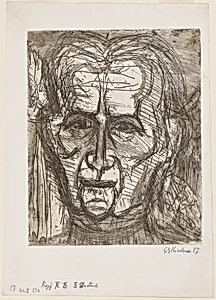
Head of Frau Bauer
Medium
drypoint with aquatint, printed in brown
Dimensions
sheet: 31.2 × 25.2 cm (12 5/16 × 9 15/16 in.)
Classification
Department
CG-E
Museum
National Gallery of Art, Washington, D.C.
Credit
Ruth and Jacob Kainen Memorial Acquisition Fund
Accession Number
2020.122.2
Rights
Public Domain
Art Historical Context
Ernst Ludwig Kirchner's *Head of Frau Bauer*1927) captures the raw emotional intensity characteristic of German Expressionism. As a founding member of the Die Brücke group, revolutionized early 20th-century art his bold, distorted forms and vivid psychological depth. Created late in his career while living in Switzerland amid personal struggles, this intimate portrait reflects his shift toward more introspective subjects, portraying Frau Bauer—likely a local figure—with angular features and a piercing gaze that conveys inner turmoil and resilience. The work is a masterful drypoint with aquatint, printed in warm brown ink on a modest sheet (31.2 × 25.2 cm). Drypoint's direct needle engraving produces velvety, burr-rich lines for expressive contours, while aquatint adds subtle tonal gradations, mimicking the textured depth of painting in print form. This hybrid technique highlights Kirchner's printmaking prowess, bridging his earlier woodcuts with refined intaglio methods, and underscores prints' democratic accessibility during the Weimar era. Housed in the National Gallery of Art's collection through the Ruth and Jacob Kainen Memorial Acquisition Fund, *Head of Frau Bauer* exemplifies Kirchner's enduring influence on modern graphic arts, inviting viewers to ponder the human spirit's complexity.
About the Artist
Ernst Ludwig Kirchner · 1880–1938
Ernst Ludwig Kirchner was born on May 6, 1880, in Aschaffenburg, Germany, to parents Ernst and Maria Kirchner, part of a family of Prussian descent that frequently relocated due to his father's career as a chemical technician. After early schooling in various towns, he studied architecture at the Königliche Technische Hochschule (Technical University) in Dresden from 1901 to 1905, taking courses i...