
Head Study (Kopfstudie)
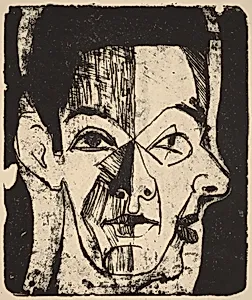
Medium
lithograph on wove paper
Dimensions
image: 32.9 x 27.3 cm (12 15/16 x 10 3/4 in.) sheet: 40.8 x 33.5 cm (16 1/16 x 13 3/16 in.)
Classification
Department
CG-W
Museum
National Gallery of Art, Washington, D.C.
Credit
Gift of Ruth Cole Kainen
Accession Number
2012.92.743
Rights
Public Domain
Art Historical Context
Ernst Ludwig Kirchner's *Head Study (Kopfie)*, created in 1924, the raw emotional intensity of German Expressionism. As a founding member of the Die Br group, Kirchner pioneered a style that rejected naturalistic representation in favor of bold colors, distorted forms, and depth, often reflecting the turmoil of modern life. This lithograph on wove paper captures a-up portrait study, with its image measuring 32.9 x 27.3 cm, the artist's mastery in conveying inner states through angular lines and stark contrasts. Lithography, Kirchner's chosen medium here, allowed for direct, spontaneous mark-making on a stone surface, transferred to paper in editions that made his work accessible beyond paintings. By 1924, after World War I and personal struggles with mental health, Kirchner's figures often embodied alienation and introspection—hallmarks of Expressionism's response to industrialization and conflict. This print's simplified yet piercing features invite viewers to ponder the human psyche. Now housed in the National Gallery of Art's Prints department (CG-W) as a gift from Ruth Cole Kainen, *Head Study* highlights Kirchner's enduring influence on 20th-century art, bridging personal expression with broader cultural anxieties of the era. A compelling glimpse into modernism's restless spirit!
About the Artist
Ernst Ludwig Kirchner · 1880–1938
Ernst Ludwig Kirchner was born on May 6, 1880, in Aschaffenburg, Germany, to parents Ernst and Maria Kirchner, part of a family of Prussian descent that frequently relocated due to his father's career as a chemical technician. After early schooling in various towns, he studied architecture at the Königliche Technische Hochschule (Technical University) in Dresden from 1901 to 1905, taking courses i...