
Headband or Belt Fragment
1476-1532
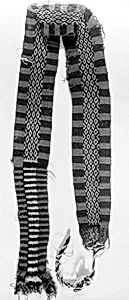
Medium
compound weave
Dimensions
91.4 × 6.4 cm (36 × 2 1/2 in.)
Classification
textile
Department
Textiles
Museum
Art Institute of Chicago
Accession Number
85046
Rights
Public Domain
Art Historical Context
This exquisite *Headband or Belt Fragment* from the Inca Empire (1476–1532) offers a glimpse into the height of Andean textile mastery during the Late Horizon period. Created at the empire's zenith under rulers like Pachacuti and Huayna Capac, such narrow bands—measuring 91.4 × 6.4 cm—were likely worn by elites as status symbols, headbands, or belts, adorning warriors, nobles, or priests in the vast Tawantinsuyu realm stretching from modern Ecuador to Chile. Crafted in compound weave, a sophisticated technique using multiple warp and weft yarns manipulated on backstrap looms, this piece exemplifies Inca innovation. Weavers, often women trained from childhood, interwove fine camelid fibers (alpaca or vicuña) to produce durable, intricate patterns symbolizing cosmology, fertility, and imperial power. The method allowed for reversible designs and complex motifs, far surpassing contemporaries in Europe or Asia. Today, housed in the Art Institute of Chicago's Textiles Department, this fragile survivor highlights the Inca's unparalleled textile legacy—once more valued than gold. Though fragmented, it whispers of a civilization where cloth wove the social fabric of empire.
About the Artist
Inca
Inca artists, operating anonymously within the vast Inca Empire from approximately 1425 to 1532 CE, were masterful creators whose works symbolized imperial power and unity across the Andes. Thriving in the heart of Cuzco, the empire's capital, these skilled artisans—men and women alike—produced textiles, ceramics, and metalwork that served both practical and ceremonial purposes. Gifted craftspeopl...