
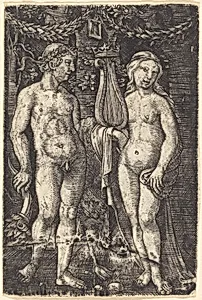
Hercules and a Muse
c. 1520/1525
Medium
engraving
Classification
Department
CG-E
Museum
National Gallery of Art, Washington, D.C.
Credit
Rosenwald Collection
Accession Number
1943.3.406
Rights
Public Domain
Art Historical Context
Albrecht Altdorfer's *Hercules and a Muse*, created around 1520–1525, is a captivating engraving from the Northern Renaissance. As a leading figure of the Danube School, Altdorfer masterfully blended intricate detail with a sense of atmospheric depth, even in this intimate print format. The work depicts the mythical hero Hercules alongside a Muse—likely symbolizing inspiration or the harmony of strength and intellect—reflecting the era's fascination with classical antiquity amid the humanist revival. Engraving, Altdorfer's chosen medium, allowed for precise, expressive lines incised into a copper plate, enabling widespread dissemination of his visionary imagery. This technique was revolutionary in early 16th-century Germany, bridging painting and printmaking while making high art accessible beyond elite patrons. Altdorfer's engravings often feature his signature delicate cross-hatching for texture and light, showcasing his innovative approach to small-scale works. Housed in the National Gallery of Art's Rosenwald Collection, this piece highlights Altdorfer's role in elevating prints to fine art status. Visitors will appreciate its mythological narrative as a window into Renaissance curiosity about ancient heroes, where physical prowess meets poetic muse. A gem of technical virtuosity and cultural synthesis!
About the Artist
Albrecht Altdorfer · 1475–1538
Albrecht Altdorfer (c. 1480–1538) was a German painter, printmaker, and draftsman who stands as one of the founders of landscape painting as an independent genre. Born in Regensburg or nearby Altdorf, he learned art from his father Ulrich, a painter and miniaturist. Altdorfer spent most of his life in Regensburg, becoming a citizen in 1505 and later serving as the city's official architect and a m...