
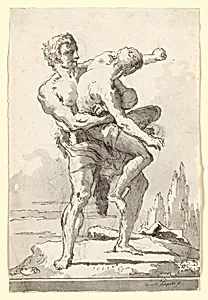
Hercules and Antaeus (with a ledge Below)
late 18th century
Medium
Pen and brown ink, gray wash, over black chalk
Dimensions
7 7/8 x 5 1/2 in. (20 x 14 cm)
Classification
Drawings
Department
Robert Lehman Collection
Museum
Metropolitan Museum of Art, New York, NY
Credit
Robert Lehman Collection, 1975
Accession Number
1975.1.492
Rights
Public Domain
Tags
Art Historical Context
In the Robert Lehman Collection at the Metropolitan Museum of Art, Giovanni Tiepolo's *Hercules and Antaeuswith a ledge Below)* a dramatic moment from classical mythology. Created in the late 18th century this intimate drawing (7 7/8 x 5 1/2 in.) depicts the Hercules lifting the giant Antaeus off the ground—and away from the earthbound ledge that fuels his strength. As the son of the famed Venetian Rococo master Giambatt Tiepolo, Domenico inherited his father's flair for dynamic figures and theatrical energy, blending mythological grandeur with elegant, fluid lines. Executed in pen and brown ink with gray wash over black chalk, the work exemplifies Tiepolo's virtuoso drawing technique. The preliminary black chalk underdrawing provides subtle structure, while the ink outlines and wash add depth, shadow, and muscular tension, evoking the torsion of combat. This mixed-media approach was common in Venetian workshops for studies that could inform paintings or frescoes, highlighting the preparatory artistry of the Rococo era as it waned into Neoclassicism. A gem of the Lehman Collection since 1975, this piece offers visitors a window into 18th-century draftsmanship's immediacy and power. Tiepolo's vivid portrayal not only celebrates Hercules' triumph but also underscores the enduring cultural fascination with heroic strength in Western art.
About the Artist
Giovanni Domenico Tiepolo · 1727–1804
Giovanni Domenico Tiepolo (1727-1804) was a Venetian painter, printmaker, and draftsman whose career spanned the twilight of the Rococo era. Born on August 30, 1727, in Venice as the eldest son of the celebrated Giovanni Battista Tiepolo, he worked both in his father's shadow and as a significant independent artist who developed a distinctly earthbound and humanistic vision. Domenico's importance...