
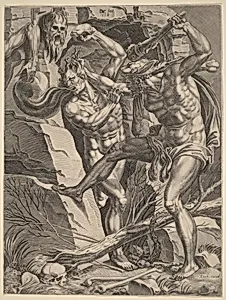
Hercules Killing Cacus
Medium
engraving on laid paper
Dimensions
sheet (trimmed to plate mark): 35.9 x 26.9 cm (14 1/8 x 10 9/16 in.)
Classification
Department
CG-E
Museum
National Gallery of Art, Washington, D.C.
Credit
Ailsa Mellon Bruce Fund
Accession Number
1975.35.2
Rights
Public Domain
Art Historical Context
Behold the dynamic engraving *Hercules Killingacus* (1554) by Dirck Volckertz Cohert, a masterful Dutch artist active during the Northern Renaissance. This print captures a pivotal moment from classical mythology: the mighty hero Hercules slaying the fire-breathing giant Cacus, who had stolen his cattle and hidden them in a cave. Coornhert's intricate line work brings the muscular struggle to life, emphasizing Hercules' triumph over chaos—a theme resonating with Renaissance ideals of heroism and order. Created as an engraving on laid paper (35.9 x 26.9 cm), the work showcases the medium's revolutionary potential in the 16th century. Engraving allowed for precise, reproducible images from copper plates, making sophisticated art accessible beyond elite patrons. Produced in Antwerp's vibrant print workshops, it likely drew from designs by contemporaries like Maarten van Heemskerck, fueling the era's fascination with ancient tales amid humanism's rise. Today, housed in the National Gallery of Art (acquired via the Ailsa Mellon Bruce Fund), this trimmed sheet exemplifies how prints bridged classical antiquity and early modern Europe, educating and inspiring viewers with vivid storytelling through artistry alone.