
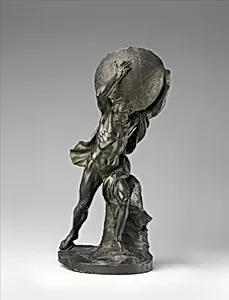
Hercules or Atlas Supporting the Globe
ca. 1780
Medium
Terracotta, painted to resemble bronze
Dimensions
Height: 15 5/8 in. (39.7 cm)
Classification
Sculpture
Culture
French, Paris
Department
European Sculpture and Decorative Arts
Museum
Metropolitan Museum of Art, New York, NY
Credit
Gift of J. Pierpont Morgan, 1906
Accession Number
07.225.379
Rights
Public Domain
Tags
Art Historical Context
Clodion (Claude), a leading French sculptor of the late 18th century, *Hercules or Atlas the Globe* around 1780 during the waning years of the Rococo era in Paris. This dynamic terracotta sculpture captures a muscular mythological figure—likely Atlas, condemned to hold up the heavens, or Hercules during his Twelve Labors—straining under the weight of a celestial globe. Standing just over 15 inches tall, exemplifies Clodion's mastery of playful yet vigorous forms, blending Rococo elegance with emerging Neoclassical vigor. The medium is particularly noteworthy: terracotta, a malleable clay favored for sculptors' preliminary models (bozzetti), is here skillfully painted to mimic the patina of bronze, creating a trompe l'oeil effect that enhances its decorative appeal. This technique highlights Clodion's versatility, as he often produced such works for elite patrons' interiors or as studies for larger commissions. Housed in the Metropolitan Museum of Art's European Sculpture and Decorative Arts department, it was generously gifted by J. Pierpont Morgan in 1906. Mythological strongmen like Atlas symbolized endurance and cosmic order, resonating in French decorative arts amid Enlightenment fascination with antiquity. This charming yet powerful piece invites visitors to ponder the blend of human striving and divine burden, a timeless theme rendered with Clodion's signature fluidity and joie de vivre.