
Hercules Slaying the Lernean Hydra
Medium
engraving
Dimensions
67; 106
Rights
Public Domain
About this artwork
height 106 mm x width 67 mm
Art Historical Context
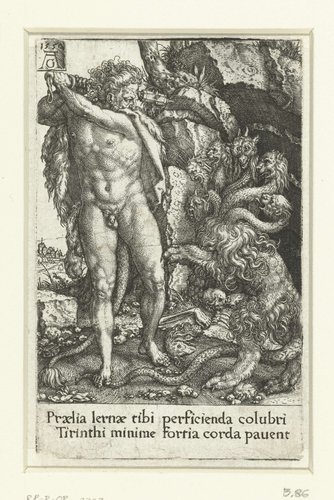
Behold the dynamic engraving *Hercules Slaying the Lernean Hydra* by Heinrich Aldegrever, created in 1550. This petite masterpiece, measuring just 106 mm high by 67 mm wide, captures the second labor of the mythical hero Hercules from Greek mythology. Aldegrever, a prominent German artist of the Northern Renaissance and one of the "Little Masters," depicts Hercules battling the multi-headed serpent in the swamps of Lerna, sword raised triumphantly amid writhing forms—a vivid nod to classical antiquity revived during the Renaissance. As an engraving, this work exemplifies the era's innovative printmaking techniques. Aldegrever's precise burin incisions on a copper plate allowed for intricate details in a compact format, enabling widespread dissemination of mythological narratives to collectors and scholars across Europe. Northern Renaissance engravers like him blended Gothic precision with emerging Italian influences, producing affordable art that democratized heroic tales. This piece highlights 16th-century fascination with humanism and antiquity, serving as both decoration and moral allegory of perseverance. Aldegrever's skillful line work brings the chaos of myth to life, inviting viewers to marvel at heroism in miniature.
About the Artist
Heinrich Aldegrever · 1502–1561
Heinrich Aldegrever, born in 1502 in Paderborn, Westphalia, to parents Herman and Katherine Trippenmeker—a family of clog-makers known by the dialect name Trippenmecker—emerged as a multifaceted artist in the German Renaissance. His early training remains undocumented, though he likely apprenticed in a Soest goldsmith's workshop after relocating there around 1525, where he joined the painters' gui...