
Adam
Medium
engraving
Dimensions
55; 40
Rights
Public Domain
About this artwork
datum
Art Historical Context
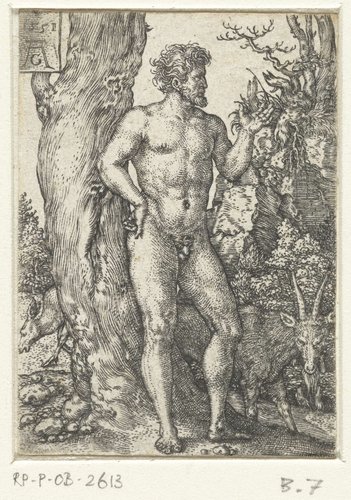
Behold Heinrich Aldegrever's enchanting engraving *Adam* (1551), a diminutive masterpiece measuring just 55 mm high by 40 mm wide. Crafted during the Northern Renaissance, this tiny print exemplifies the precision of 16th-century German printmaking. Aldegrever, a goldsmith-turned-engraver from Soest, Westphalia, was one of the celebrated "Little Masters," renowned for their virtuoso work in small formats that rivaled paintings in detail. Engraving, an intaglio technique where lines are incised into a metal plate and inked under pressure, allowed Aldegrever to achieve extraordinary finesse. The medium was revolutionary for its time, enabling affordable reproduction and widespread dissemination of images to collectors, scholars, and the devout across Europe. Aldegrever's biblical subjects, like this depiction of Adam, drew from Renaissance humanism, blending classical anatomy with Christian iconography to explore the human form's divine origins. This intimate work invites us to marvel at Adam's poised figure, a testament to Aldegrever's skill in capturing texture and expression on a jewel-like scale. Likely collected in albums or set into jewelry, it reflects the era's fusion of art, faith, and craftsmanship, bridging personal devotion with artistic innovation.
About the Artist
Heinrich Aldegrever · 1502–1561
Heinrich Aldegrever, born in 1502 in Paderborn, Westphalia, to parents Herman and Katherine Trippenmeker—a family of clog-makers known by the dialect name Trippenmecker—emerged as a multifaceted artist in the German Renaissance. His early training remains undocumented, though he likely apprenticed in a Soest goldsmith's workshop after relocating there around 1525, where he joined the painters' gui...