
Hexagonal Jug
Unknown Artist
500–650
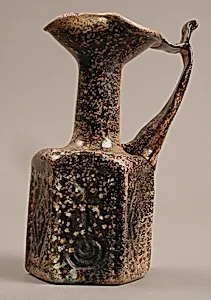
Medium
Moulded glass
Dimensions
Overall: 6 3/16 x 2 15/16 x 2 11/16 in. (15.7 x 7.4 x 6.8 cm)
Classification
Glass-Vessels
Culture
Byzantine
Department
Medieval Art
Museum
Metropolitan Museum of Art, New York, NY
Credit
Mr. and Mrs. Isacc D. Fletcher Collection, Bequest of Isaac D. Fletcher, 1917
Accession Number
17.120.246
Rights
Public Domain
Art Historical Context
Step into the enchanting world of Byzantine craftsmanship with this *Hexagonal Jug*, a vessel crafted by an unknown artist between 500 650 CE. Measuring just over 6 inches tall, its compact form—6 3/16 x 2 15/16 x 2 11/16 inches (15.7 x 7.4 x 6.8 cm)—features six faceted sides, making it both functional and visually striking. Made of moulded glass, this piece exemplifies the sophisticated glassworking techniques of the Byzantine Empire, centered in the Eastern Mediterranean. Moulded glass, as seen here, was a pivotal innovation during this period, allowing artisans to create precise, geometric shapes that free-blown glass could not achieve. The hexagonal design likely served practical purposes, such as stable pouring for oils, perfumes, or wine, while reflecting the era's love for symmetry and order—influenced by Roman and early Christian aesthetics. Byzantine glass production thrived in workshops from Syria to Egypt, blending utility with subtle elegance. Housed in the Metropolitan Museum of Art's Medieval Art Department, this jug entered the collection through the generous bequest of Mr. and Mrs. Isaac D. Fletcher in 1917. It offers a tangible glimpse into daily Byzantine life, where even humble vessels showcased technical mastery and cultural refinement, bridging antiquity and the medieval world.