
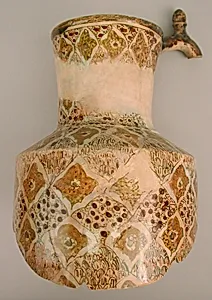
Fragmentary Ewer with Polychrome Luster Decoration
Unknown Artist
9th century
Medium
Earthenware; polychrome luster-painted on opaque white glaze
Dimensions
Max. H. 11 3/4 in. (29.8 cm) Max. Diam. 8 1/2 in. (21.6 cm) Diam. of Rim: 4 3/4 in. (12.1 cm)
Classification
Ceramics
Department
Islamic Art
Museum
Metropolitan Museum of Art, New York, NY
Credit
Gift of Mrs. Charlotte M. Bradford, in memory of Professor Ernst Herzfeld, 1954
Accession Number
54.71.1
Rights
Public Domain
Art Historical Context
This exquisite fragmentary ewer, dating to the 9th century, offers a glimpse into the golden of Islamic ceramics during theid era. Crafted from earthenware and adorned with polychrome luster over an opaque white glaze, once served as a elegant vessel for pouring liquids, its graceful form evoking the luxury of contemporary metalwork. Though incomplete, its maximum height of nearly 12 inches hints at a substantial, functional object prized for both utility and beauty in medieval Islamic households. The standout feature is the innovative luster-painting technique, where metallic oxides were applied to the glazed surface and fired in a reducing atmosphere to produce a shimmering, iridescent effect in multiple colors. This polychrome lusterware, likely originating from workshops in Iraq or Syria, represented a pinnacle of ceramic artistry, rivaling costly gold and silver wares while making opulence accessible. Its opaque white tin-glaze base provided a luminous canvas, showcasing the technical mastery of anonymous potters who guarded their secrets closely. Housed in the Metropolitan Museum of Art's Islamic Art department as a gift honoring archaeologist Ernst Herzfeld, this piece underscores the cultural vibrancy of early Islamic innovation, influencing pottery traditions across the Mediterranean and beyond. Visitors, imagine the soft glow of candlelight dancing on its surface during a lavish feast!