
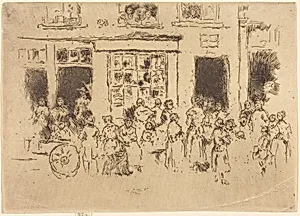
High Street, Brussels
Medium
etching on laid paper
Dimensions
overall (trimmed to plate): 12.6 × 17.7 cm (4 15/16 × 6 15/16 in.)
Classification
Department
CG-W
Museum
National Gallery of Art, Washington, D.C.
Credit
Rosenwald Collection
Accession Number
1943.3.8623
Rights
Public Domain
Art Historical Context
James McNeill Whistler’s *High Street, Brussels*1887) captures a bustling urban scene in the Belgian capital, rendered with the artist’s signature subtlety and atmospheric finesse. Whistler, an American-born and printmaker who championed the Aesthetic movement in late 19th-century Britain created this etching during a period of European travel that inspired his evocative cityscapes. Departing from the detailed realism of earlier etchings like his Thames Set, this work reflects his mature style: a harmonious interplay of light, shadow, and suggestion, prioritizing mood over narrative. Etched on laid paper—a textured, handmade sheet that enhances the print’s tactile quality—this intimate piece (just 12.6 × 17.7 cm) showcases Whistler’s revolutionary printmaking technique. He used soft-ground etching and drypoint to achieve velvety tones and delicate lines, blurring the boundaries between drawing, painting, and print. These methods allowed for subtle gradations, evoking the fleeting haze of twilight on cobblestone streets lined with figures and architecture. Housed in the National Gallery of Art’s Rosenwald Collection, *High Street, Brussels* exemplifies Whistler’s influence on modern art, bridging Impressionism’s light effects with Symbolism’s emphasis on harmony. Visitors will appreciate its quiet poetry, inviting a lingering gaze at everyday life transformed into timeless beauty.
About the Artist
James McNeill Whistler · 1834–1903
James Abbott McNeill Whistler (1834-1903) was an American-born painter and printmaker who became a leading figure in the Aesthetic Movement and pioneer of Tonalism and Japonisme. He revolutionized art by championing "art for art's sake" and treating paintings as visual equivalents of musical compositions, titling works as "arrangements," "harmonies," and "nocturnes" to emphasize formal qualities o...