
History of Kamakura
19th century
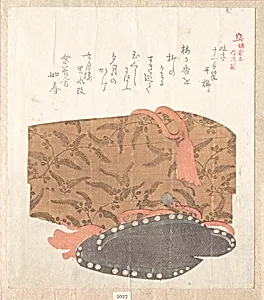
Medium
Woodblock print (surimono); ink and color on paper
Dimensions
8 1/4 x 7 1/4 in. (21 x 18.4 cm)
Classification
Prints
Culture & Period
Japan · Edo period (1615–1868)
Department
Asian Art
Museum
Metropolitan Museum of Art, New York, NY
Credit
H. O. Havemeyer Collection, Bequest of Mrs. H. O. Havemeyer, 1929
Accession Number
JP2027
Rights
Public Domain
Art Historical Context
Kubo Shunman's *History of Kamakura* a delicate woodblock print from Japan's Edo (1615–1868), the legacy of Kamakura, the 12th-century samurai capital that shaped medieval Japan. Created in the 19th as a *surimono*—a luxurious, privately commissioned print often produced for New Year's greetings or poetry circles—this intimate work measures just 8¼ x 7¼ inches, emphasizing its role as a treasured personal object rather than mass-produced art. Shunman, a master of ukiyo-e ("pictures of the floating world"), excelled in surimono's refined techniques: vibrant inks layered with subtle embossing and mica for a shimmering effect, all carved meticulously onto woodblocks. The print likely illustrates key historical moments from Kamakura's era, blending narrative storytelling with poetic elegance, a hallmark of Edo-era print culture that democratized art for urban elites. Housed in the Metropolitan Museum of Art's H. O. Havemeyer Collection, this piece highlights Japan's innovative printmaking tradition, bridging history and aesthetics in a format that invited contemplation and social exchange. A window into feudal Japan's enduring fascination with its warrior past.
About the Artist
Kubo Shunman · 1757–1820
Japanese, 1757–1820