
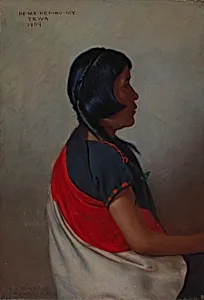
Ho-me-hep-no-my
Medium
Painting
Classification
Painting
Department
Smithsonian Collection
Museum
Smithsonian American Art Museum
Credit
Smithsonian American Art Museum, Bequest of Victor Justice Evans
Accession Number
1985.66.362,041
Rights
Public Domain
Tags
Art Historical Context
**Ho-me-hep-no-my** (1904) is a compelling waist-length portrait by Elbridge Ayer Burb, a prolific American artist renowned for his ethnographic depictions of Native American leaders and elders. Captured in oil on canvas, this painting from the Smithsonian American Art's collection showcases Burbank's dedication to preserving Indigenous likenesses during a pivotal era of cultural documentation. The subject, identified by the Tewa name "Ho-me-hep-no-my," hails from the Tewa Pueblo people of the American Southwest, whose vibrant traditions in New Mexico and beyond were increasingly documented by artists and anthropologists at the turn of the 20th century. Burbank's work reflects the early 1900s fascination with Native American cultures amid rapid societal changes, including U.S. expansion and assimilation policies. Traveling extensively to reservations and pueblos, he painted over 1,200 portraits, often from life, emphasizing dignity and individuality rather than stereotypes. This piece, bequeathed by Victor Justice Evans, contributes to the Smithsonian's rich archive of American portraiture, highlighting Tewa heritage—known for their matrilineal clans, kiva ceremonies, and artistic pottery traditions. Artistically, Burbank employed a realistic style with meticulous attention to facial features, traditional attire, and symbolic adornments, making "Ho-me-hep-no-my" a vivid window into Tewa identity. For visitors, it invites reflection on the intersection of art, ethnography, and cultural resilience. (198 words)