
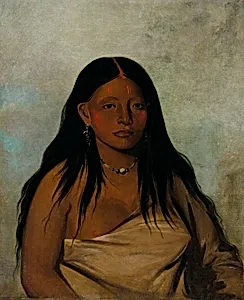
Shé-de-ah, Wild Sage, a Wichita Woman
1834
Medium
Painting
Classification
Painting
Department
Smithsonian Collection
Museum
Smithsonian American Art Museum
Credit
Smithsonian American Art Museum, Gift of Mrs. Joseph Harrison, Jr.
Accession Number
1985.66.59
Rights
Public Domain
Tags
About this artwork
George Catlin probably painted this portrait of Wild Sage at Fort Gibson, in present-day northeastern Oklahoma. Catlin noted that she was one of two young women who had been held prisoner by the Osages, and purchased and returned to her own tribe by the Indian commissioner. “Amongst the women of this tribe [Wichita], there were many that were exceedingly pretty in feature and in form; and also in expression, though their skins are very dark . . . [They] are always decently and comfortably clad, ...
Art Historical Context
**Shé-de-ah, Wild Sage, a Wichita Woman (1834) is a poignant portrait by George Catlin the pioneering 19th-century artist renowned for his extensive documentation of Native American. Catlin painted this-length image of the Wichita, likely at Fort Gibson in present-day northeastern Oklahoma, as part of his ambitious "Indian Gallery" project. Traveling the frontier in the 1830s, he sought to capture indigenous peoples' likenesses and customs before rapid cultural changes from westward expansion. The subject, Shé-de (meaning "Wild Sage"), embodies resilience amid hardship. Catlin recorded her story: one of two young Wichita women held prisoner by the rival Osage tribe, she was purchased and returned to her people by a U.S. Indian commissioner. He admired the Wichita women's beauty and modesty, noting their "decently and comfortably clad" gowns of deer or elk skin reaching from chin to ankles, despite their dark complexions. This oil painting highlights Catlin's ethnographic eye, blending portraiture with cultural observation. Housed in the Smithsonian American Art Museum, this work underscores the Wichita tribe's presence on the Southern Plains and the complex intertribal dynamics of the era. Catlin's vivid, empathetic style preserves a vanishing world, offering visitors a window into Native American strength and grace. (198 words)
About the Artist
George Catlin · 1796–1872
George Catlin (1796–1872), born in Wilkes-Barre, Pennsylvania, to Putnam Catlin and Polly Sutton—who had been captured by Native Americans during the 1778 Battle of Wyoming—initially pursued a legal career. Trained at Litchfield Law School, he was admitted to the bar in 1819 but abandoned law after two years to study art in Philadelphia in 1823. Self-taught as a portraitist, Catlin quickly gained ...