
Hoe Blade
c. 1941
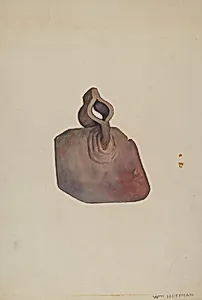
Medium
watercolor, goauche, pen and ink, and graphite on paper
Dimensions
overall: 35.5 x 24.7 cm (14 x 9 3/4 in.)
Classification
Index of American Design
Department
CG-W
Museum
National Gallery of Art, Washington, D.C.
Credit
Index of American Design
Accession Number
1943.8.11527
Rights
Public Domain
Art Historical Context
William Hoffman's *Hoe Blade* (c. 194) is a meticulous of an everyday American farming tool, captured through the of the Index of American. Created as part of ambitious WPA Federal Art Project1935–1942), artwork documents the nation's folk crafts and decorative arts at a time when industrialization threatened craftsmanship. Hoffman's depiction celebrates the humble hoe—a vital implement in American—elevating its functional form to object of aesthetic appreciation, much like the's broader mission to preserve cultural during the Great Depression. in watercolor, gouache pen and ink, and graphite on (35.5 x 24.7 cm), piece showcases a masterful blend of techniques. Transparent watercolors provide subtle tonal shifts, while opaque gouache adds depth and texture to the blade's worn metal surfaces. Fine pen lines and graphite underdrawings ensure precise contours and intricate details, reflecting the Index artists' commitment to hyper-realistic accuracy. This mixed-media approach not only replicates the tool's patina and forge marks but also highlights regional blacksmithing traditions. Housed in the National Gallery of Art, *Hoe Blade* underscores the cultural importance of utilitarian objects in American design. It invites visitors to reflect on the artistry in everyday labor, bridging fine art and folk heritage in a that remains relevant today.
About the Artist
William Hoffman · 1883–1995
William Hoffman was a self-taught painter born in 1924 in Montana, where he spent his early years working on cattle ranches across the state. After high school, he considered settling into ranch life near Choteau, but World War II intervened; he served in the United States Marine Corps, including time in the Pacific. Following the war, Hoffman attended three colleges, exploring various majors and ...