
Hooked Harp
Unknown Artist
early 19th century
Medium
Wood, various materials
Dimensions
Extreme H: 152 cm (59 13/16 in); Pillar L. 151 cm (59 7/16 in); Soundboard: resonating L. 114 cm (44 7/8 in), Greatest W. 33.2 cm (13 1/16 in); Strings (sounding length): longest 134 cm (52 3/4 in), shortest 9.7 cm (3 13/16 in)
Classification
Chordophone-Harp
Culture
German or Austrian
Department
Musical Instruments
Museum
Metropolitan Museum of Art, New York, NY
Credit
The Crosby Brown Collection of Musical Instruments, 1889
Accession Number
89.4.2125
Rights
Public Domain
Art Historical Context
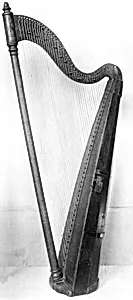
Nestled in the Metropolitan Museum of Art's renowned Crosby Brown Collection of Musical Instruments this *Hooked Harp* from the early 19th century exemplifies the craftsmanship of German or Austrian luthiers. Standing an imposing 152 cm tall with a pillar length of 151 cm, it is constructed from wood and various materials, reflecting the era's blend of functionality and elegance. Acquired in 1889, it offers a tangible link to the Romantic period, when harps graced salons and orchestras across Europe. As a chordophone classified as a harp, this instrument features hooks—small levers along the neck—that raise the pitch of strings chromatically, enabling players to perform in multiple keys without the double-action pedals of later designs. Its soundboard measures 114 cm long and 33.2 cm wide at its broadest, supporting strings ranging from a resonant 134 cm (bass) to a delicate 9.7 cm (treble). This innovative mechanism marked a pivotal evolution in harp technology, bridging folk traditions and classical music. Visitors will appreciate the harp's monumental scale and intricate construction, a testament to the skilled artisans who shaped Europe's musical heritage. Though the maker remains unknown, its preservation invites us to imagine lilting melodies echoing through 19th-century Viennese halls.