
Horse Bit
Unknown Artist
7th–9th century
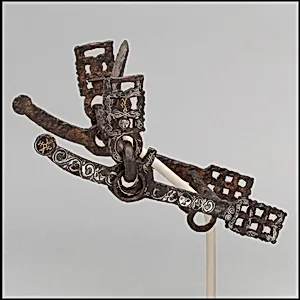
Medium
Iron inlaid with copper alloy, gold, and silver
Dimensions
Overall: 10 5/8 x 7 1/16 x 5 5/16 in. (27 x 18 x 13.5 cm)
Classification
Metalwork-Iron
Culture
Visigothic or Byzantine
Department
Medieval Art
Museum
Metropolitan Museum of Art, New York, NY
Credit
Fletcher Fund, 1947
Accession Number
47.100.24
Rights
Public Domain
Art Historical Context
Step into the world of early medieval equestrian artistry with this exquisite *Horse Bit*, crafted by an unknown artist between the 7th 9th centuries.ributed to either Visigothic or Byzantine, this functional piece from the Metropolitan Museum of Art's Medieval Art collection highlights the sophistication of horse gear in a turbulent era. Visigoths ruled much of the Iberian Peninsula after the fall of Rome, while Byzantine influences radiated from the Eastern Roman Empire—both societies prized skilled horsemanship for warfare and travel. Forged from iron and masterfully inlaid with copper alloy, gold, and silver, the bit measures 10 5/8 x 7 1/16 x 5 5/16 inches, showcasing advanced metalworking techniques like intricate inlay that elevated everyday tools into symbols of prestige. These precious metal accents would have gleamed under sunlight, denoting the rider's status among warriors or nobility. As a rare survivor of iron metalwork, this artifact reveals cultural exchanges across the Mediterranean, blending utility with ornamental flair. Acquired through the Fletcher Fund in 1947, it invites us to imagine thundering hooves on ancient battlefields, a testament to the enduring artistry of medieval craftsmen.