
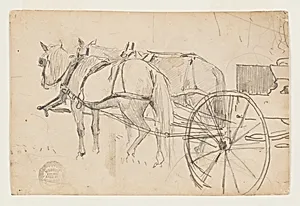
Horses and Wagon (The Picnic Excursion)
Classification
nature studies
Department
Smithsonian Collection
Museum
Smithsonian American Art Museum
Credit
Gift of Charles Savage Homer, Jr.
Accession Number
1912-12-260
Rights
Public Domain
About this artwork
Research in Progress
Art Historical Context
**Horses and Wagon (The Picnic Excursion)**, painted by Winslow Homer in 1868, captures a serene moment of rural leisure in post-Civil War America. Homer, a pioneering American Realist (1836–1910), often depicted everyday scenes of American life with unflinching honesty and vitality. This work, classified as a nature study, likely portrays horses pulling a wagon on a picnic outing, evoking the simple joys of the countryside amid the nation's recovery from war. The title suggests a lighthearted excursion, reflecting the era's growing appreciation for outdoor recreation and escape from urban industrialization. Homer's style emphasized natural light, dynamic compositions, and a keen observation of human interaction with the environment, marking a shift from his earlier Civil War illustrations to intimate landscapes. Created just three years after the war's end, it embodies the optimism of Reconstruction, when Americans sought solace in nature. Though the medium is unknown, Homer's nature studies were foundational to his masterful oils and watercolors, honing his ability to convey motion and atmosphere. A cherished gift from Charles Savage Homer, Jr., to the Smithsonian American Art Museum, this piece invites visitors to ponder the enduring appeal of pastoral harmony. Research continues to uncover more about its creation, but it stands as a testament to Homer's legacy in celebrating America's heartland.