
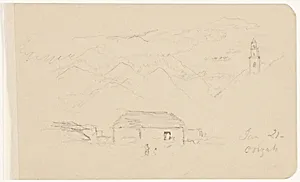
House in Orizaba, Mexico
January 21, 1893
Classification
landscapes
Department
Smithsonian Collection
Museum
Smithsonian American Art Museum
Credit
Gift of Louis P. Church
Accession Number
1917-4-1041-a
Rights
Public Domain
About this artwork
Research in Progress
Art Historical Context
Frederic Edwin Church, leading figure in the Hudson River School of American landscape painting, created *House in Orizaba Mexico* on January 21, 1893. Renowned for his epic vistas of the natural world—like *Niagara* (1857) and *Heart of Andes* (1859)—Church drew inspiration from extensive travels to South America and beyond. By the 1890s, late in his career and battling rheumatoid arthritis, he turned to more intimate scenes, capturing the everyday beauty of distant locales like Orizaba, a picturesque city in Veracruz, Mexico, nestled near the towering Pico de Orizaba volcano. This landscape reflects Church's masterful eye for light, atmosphere, and detail, hallmarks of the luminist style that emphasized transcendental connections between humanity and nature. Though the medium remains unidentified amid ongoing research, it exemplifies his lifelong fascination with exotic terrains, blending precise observation with romantic idealism. Donated to the Smithsonian American Art Museum by his son, Louis P. Church, the work offers a rare glimpse into the artist's later years, inviting visitors to ponder how a simple house amid Mexican mountains echoes the grandeur of his earlier masterpieces. (Word count: 198)