
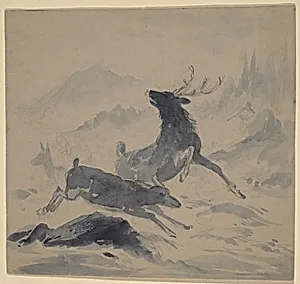
Hunter and Fleeing Deer
1826 to 1850
Medium
graphite with blue wash on wove paper
Dimensions
sheet: 11.4 × 12 cm (4 1/2 × 4 3/4 in.)
Classification
Drawing
Department
CG-W
Museum
National Gallery of Art, Washington, D.C.
Credit
John Davis Hatch Collection
Accession Number
1984.7.84
Rights
Public Domain
Art Historical Context
Thomas Moran's *Hunter and Fleeing Deer*, created between 1826 and 1850, is a captivating small-scale drawing executed in graphite with blue wash onove paper, measuring just11.4 × 12 cm. This intimate work captures a tense moment in nature: a hunter in pursuit of a leaping deer, rendered with swift, economical lines that convey motion and urgency. Housed in the National Gallery of Art's John Davis Hatch Collection (Department CG-W), it exemplifies the artist's early mastery of draftsmanship on a portable scale. Moran, a prominent figure in the Hudson River School and later celebrated for his luminous landscapes of the American West, often produced such preparatory sketches to study light, form, and wildlife. The graphite provides precise detailing—fur texture, musculature—while the blue wash introduces atmospheric depth, evoking misty wilderness or twilight hues. This mixed-media technique was common in 19th-century sketchbooks, allowing artists to experiment quickly en plein air or in the studio. As a classified drawing, it offers a glimpse into Moran's process during a formative period, highlighting Romantic themes of man versus untamed nature. For visitors, it's a reminder of how these modest studies fueled grander visions of America's frontier spirit.
About the Artist
Thomas Moran · 1837–1926
Thomas Moran (1837–1926) was an American painter and printmaker of the Hudson River School whose dramatic paintings of the American West played a pivotal role in the creation of the national parks. Born in Bolton, Lancashire, England, he emigrated with his family to Philadelphia as a child. He was largely self-taught, though he apprenticed briefly with a wood engraver and studied the work of J.M.W...