
Hydria (Water Jar)
360-350 BCE
Medium
terracotta, red-figure
Dimensions
53 × 41.2 × 34.2 cm (20 7/8 × 16 1/4 × 13 1/2 in.)
Classification
vessel
Department
Arts of Greece, Rome, and Byzantium
Museum
Art Institute of Chicago
Accession Number
102082
Rights
Public Domain
About this artwork
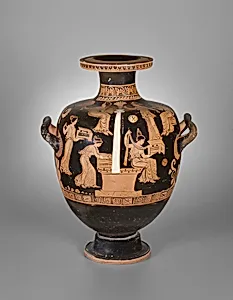
In ancient Greece it was considered uncivilized to consume undiluted wine, so water was fetched from a public fountain house in a large handled jar like this one and used to dilute large quantities of wine. The horizontal handles made it easier to carry, while the vertical handle at the back was used for pouring. On the front of the vessel, six female figures are arranged around a funeral momument, topped by a tall white pillar. Some of the women are standing while others are seated, and hold ob...
Art Historical Context
This elegant terracotta hydria, or water jar, was crafted in southern Italy around 360–350 BCE by the Iliupersis Painter, a master of the red-figure technique. In this innovative method, artists reserved the natural red clay for figures and details while coating the background with black slip, allowing for greater anatomical precision, expressive gestures, and intricate drapery compared to earlier black-figure styles. Such vessels were essential in daily Greek life for fetching and storing water, yet their elaborate decoration elevated them to objects of beauty and status. Measuring over twenty inches tall, the hydria’s graceful proportions and three handles reflect both practical design and aesthetic refinement typical of the late Classical period. The Iliupersis Painter’s work often graced Apulian pottery, blending Greek mythological themes with local tastes and helping spread Hellenic artistic traditions across the Mediterranean. Today in the Art Institute of Chicago, this vessel offers visitors a vivid connection to ancient rituals of hospitality, purification, and storytelling, reminding us how functional objects became lasting expressions of cultural identity and artistic skill.