
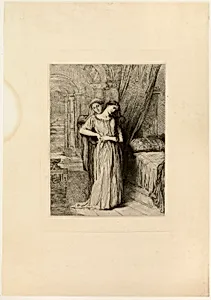
If I Do Die Before Thee, plate eight from Othello
Medium
Etching, engraving and drypoint on off-white China paper, laid down on cream wove paper
Dimensions
Image: 28.5 × 21.5 cm (11 1/4 × 8 1/2 in.); Sheet: 29.2 × 22.3 cm (11 1/2 × 8 13/16 in.)
Classification
etching
Department
Prints and Drawings
Museum
Art Institute of Chicago
Accession Number
40801
Rights
Public Domain
Art Historical Context
In the Prints and Drawings department of the Art Institute of Chicago, Théodore Chassériau *If I Do Die Before, plate eight from Othello* (1844) captures a poignant moment from Shakespeare's tragedy. This etching draws from the play's climactic scene where Othello bids Desdemona to shroud him in her bedsheets if he dies first, evoking themes of love, jealousy, and doom. At just 25, Chassériau—a prodigious French artist blending Romantic passion with Neoclassical precision—included this as part of a rare series of eight prints inspired by Othello, showcasing his early mastery of dramatic narrative in print form. Crafted through etching, engraving, and drypoint on delicate off-white China paper (then laid down on cream wove paper for preservation), the work measures a intimate 28.5 × 21.5 cm. These intaglio techniques allowed Chassériau to achieve rich tonal contrasts: etching for fluid lines via acid bite, engraving for crisp definition with a burin, and drypoint for velvety textures from a raised burr. China paper's thin, absorbent quality enhanced ink saturation, making fine details pop—ideal for intimate study or collector's albums. This plate highlights 19th-century fascination with Shakespeare in visual art, bridging literature and Romanticism. Chassériau's expressive handling elevates the print beyond mere illustration, inviting viewers to ponder Othello's tragic intimacy in a format both accessible and technically virtuoso.
About the Artist
Théodore Chassériau · 1819–1856
Théodore Chassériau was born on September 20, 1819, in El Limón, Samaná, in the Spanish colony of Santo Domingo — present-day Dominican Republic — to a French father and a Creole mother. The family relocated to Paris in 1820, and the young Chassériau's exceptional talent was evident almost immediately. At just eleven years old, in 1830, he was accepted into the prestigious studio of Jean-Auguste-D...