
IJsvogel jagend op vis
1900 - 1961
Medium
color woodcut
Dimensions
189; 345
Rights
Public Domain
About this artwork
height 345 mm x width 189 mm
Art Historical Context
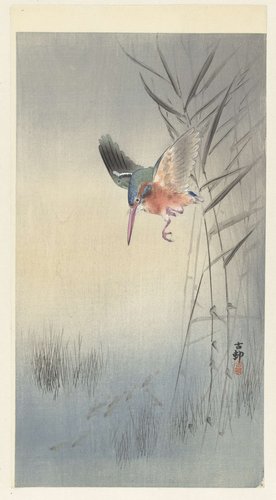
Ohara Koson’s “IJsvogel jagend op vis” captures a fleeting moment of natural drama in a delicate color woodcut. Created between 1900 and 1961, the print depicts a kingfisher poised in mid-hunt above the water, its vivid plumage contrasting sharply with the rippling surface below. Koson, renowned for his kacho-e (bird-and-flower) subjects, infused traditional Japanese printmaking with a refined sense of observation and quiet tension. As a color woodcut, the work relies on the precise carving of multiple cherry-wood blocks, each inked with a different hue and printed in careful registration. This painstaking technique allows subtle gradations of blue, turquoise, and warm orange that bring the bird’s feathers and the water’s reflections to life. The modest size—345 by 189 millimeters—invites close viewing, rewarding the eye with fine details such as the glint in the kingfisher’s eye and the faint ripples spreading outward. Koson’s prints from this era reflect a bridge between centuries-old ukiyo-e traditions and early twentieth-century sensibilities, appealing to both Japanese collectors and Western audiences drawn to the elegance of nature. The scene’s balance of stillness and implied motion offers viewers a timeless reminder of the precision and beauty found in the natural world.
About the Artist
Ohara Koson · 1877–1945
Ohara Koson (1877-1945) was the most successful ukiyo-e artist of the shin-hanga period, renowned for his mastery of kacho-e (bird-and-flower prints). Born in Kanazawa and dying in Tokyo, Koson produced approximately 500 prints during a prolific career that spanned the late Meiji, Taisho, and early Showa periods. His work exemplifies the shin-hanga movement's successful adaptation of traditional J...