
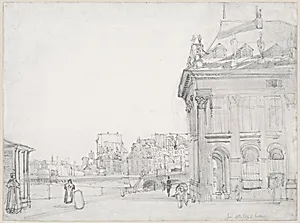
Ile de la Cité from the Institut, Paris
c. 1832
Medium
graphite with stumping on wove paper
Dimensions
overall: 24.2 x 32.7 cm (9 1/2 x 12 7/8 in.)
Classification
Drawing
Department
CG-E
Museum
National Gallery of Art, Washington, D.C.
Credit
Gift of Lowell Libson in honor of Donald Stone
Accession Number
2007.72.1
Rights
Public Domain
Art Historical Context
Thomas Shotter Boys’s delicate graphite drawing captures a serene view of Paris’s Île de la Cité from the terrace of the Institut de France. Created around 1832, the work presents the graceful curve of the Seine and the distant silhouette of Notre-Dame Cathedral, rendered with remarkable precision and atmospheric softness. Boys, an English artist celebrated for his topographical watercolors and lithographs, here demonstrates his skill in graphite, a medium prized in the early nineteenth century for its ability to record architectural detail while evoking light and space. The technique of “stumping”—rubbing the graphite with a rolled paper tool—allows Boys to create velvety tonal gradations that give the river and sky a luminous, almost painterly quality. This refined approach reflects the period’s growing interest in on-site sketching as both an artistic practice and a form of visual documentation, bridging the gap between finished exhibition pieces and preparatory studies. As a gift to the National Gallery of Art, the drawing offers today’s visitors an intimate glimpse of Paris just before the major urban transformations of the Second Empire. Its modest scale and quiet observation invite close looking, revealing how nineteenth-century artists used drawing to preserve the character of a rapidly changing city.
About the Artist
Thomas Shotter Boys · 1803–1874
Thomas Shotter Boys was born on 2 January 1803 in Pentonville, London, and received his first professional training as an apprentice to the engraver George Cooke. When his apprenticeship concluded he crossed the Channel to Paris, a move that would transform his artistic direction entirely. There he encountered Richard Parkes Bonington, the brilliant English watercolourist whose fresh, luminous ren...