
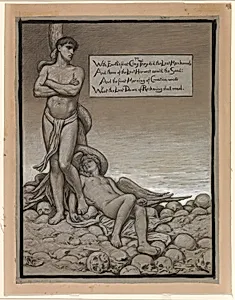
(Illustration for Rubáiyát of Omar Khayyám) The Last Man
1883-1884
Medium
Drawing
Classification
Drawing
Department
Smithsonian Collection
Museum
Smithsonian American Art Museum
Credit
Smithsonian American Art Museum, Museum purchase and gift from Elizabeth W. Henderson in memory of her husband Francis Tracy Henderson
Accession Number
1978.108.40
Rights
Public Domain
Tags
Art Historical Context
Elihu Vedder’s 1883–1884 drawing, created as an illustration for Edward FitzGerald’s translation of the Rubáiyát of Omar Khayyám, captures the poem’s haunting meditation on mortality. As one of America’s leading Symbolist artists, Vedder infused the scene with quiet drama, using the nude figure of “The Last Man” to embody the final witness to human existence. A skull and an angel hover nearby, distilling the Rubáiyát’s themes of transience and the unknown into a single, contemplative image. Executed in drawing media, the work reveals Vedder’s precise line work and atmospheric shading, techniques that allowed his illustrations to feel both intimate and monumental when reproduced in the lavish 1884 edition. The Smithsonian American Art Museum acquired the sheet through a combination of museum purchase and a generous gift, preserving it as a key example of late-nineteenth-century American engagement with Persian poetry and the era’s fascination with life’s impermanence. Today the drawing invites viewers to linger on Vedder’s restrained yet powerful symbols—an angel’s wing, a bare skull, a solitary human form—and to consider how art can give shape to life’s deepest questions.
About the Artist
Elihu Vedder · 1836–1923
Elihu Vedder was born on February 26, 1836, in New York City to Dr. Elihu Vedder Sr., a dentist, and his cousin Elizabeth Vedder. As a young boy, his family relocated to Cuba for his father's ventures, an experience that sparked his artistic aspirations amid the Caribbean landscapes. He later divided his time between a boarding school and his maternal grandfather Alexander Vedder's home in Schenec...