
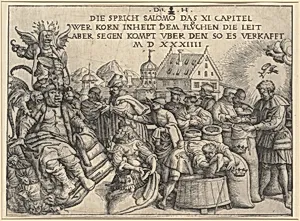
Illustration to Proverbs 11: 26
1534
Medium
Etching; second state of four
Dimensions
sheet: 7 15/16 x 10 13/16 in. (20.2 x 27.5 cm)
Classification
Prints
Department
Drawings and Prints
Museum
Metropolitan Museum of Art, New York, NY
Credit
The Elisha Whittelsey Collection, The Elisha Whittelsey Fund, 1951
Accession Number
51.501.363
Rights
Public Domain
Tags
Art Historical Context
Created in 1534 by German artist Daniel Hopfer, this etching illustrates Proverbs 11:26, a biblical verse about generosity and the consequences of hoarding grain. Hopfer, active during the early Reformation, specialized in producing affordable prints that brought religious and moral stories to a wider audience beyond church walls. The scene likely shows townspeople gathered among houses, reflecting everyday life in 16th-century Europe while conveying the proverb’s message about community and fairness. As one of the earliest artists to adapt etching—a technique originally used for decorating armor—into fine art printmaking, Hopfer helped transform the medium. Unlike engraving, etching allowed for freer, more expressive lines, which he used to create lively figures and architectural details. This impression, the second state of four, shows how printers adjusted the copper plate over time to refresh worn areas, extending the life of popular images. Measuring just under eight by eleven inches, the print’s modest size made it easy to collect and display in homes. Today it resides in the Metropolitan Museum’s collection of drawings and prints, offering visitors a glimpse into how art and scripture intersected during a period of religious change.
About the Artist
Daniel Hopfer · 1471–1536
Daniel Hopfer (c. 1470–1536), born in Kaufbeuren, was the son of the painter Bartholomäus Hopfer and Anna Sendlerin. He relocated early to Augsburg, becoming a citizen and master painter there in 1493, and trained as an etcher of armor in this thriving center of arms production. By 1505, he owned a house in the city center and served on the guild committee for smiths, which encompassed painters an...