
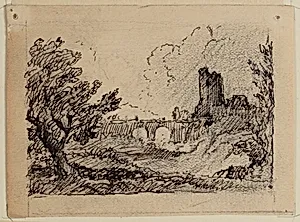
Imaginary Landscape with Ruined Tower and Bridge
Classification
landscapes
Department
Smithsonian Collection
Museum
Smithsonian American Art Museum
Credit
Gift of Louis P. Church
Accession Number
1917-4-529
Rights
Public Domain
About this artwork
Research in Progress
Art Historical Context
Frederic Edwin Church, leading figure of the Hudson River School crafted *Imaginary Landscape with Ruined Tower and Bridge* between 1870 and 1875. This American artist (1826–1900) was renowned for his sweeping, luminous landscapes that celebrated nature's sublime power, often drawing from real-world travels while infusing works with romantic imagination. By the 1870s, Church grappling with rheumatoid arthritis, curtailed his grand-scale paintings, yet his vision remained vivid, producing intimate, evocative scenes like this one. The painting depicts a fantastical vista where ancient ruins—a crumbling tower and bridge—yield to encroaching wilderness, evoking themes of transience and nature's dominance over human endeavors. This motif, common in Romantic art, reflects 19th-century American fascination with the untamed frontier and the passage of time, post-Civil War. Church's Hudson River School style emphasized dramatic light, meticulous detail, and spiritual awe, inviting viewers to ponder humanity's place in the cosmos. A cherished gift from Church's son, Louis P. Church, to the Smithsonian American Art Museum, this landscape endures as a testament to the artist's enduring legacy. Though research continues, it captivates with its blend of reality and reverie, reminding us of nature's eternal poetry.