
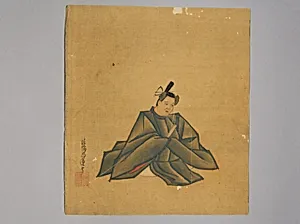
Immortal Poet
17th century
Medium
Unmounted shikisi leaf; ink and color on silk
Dimensions
7 1/4 × 6 1/2 in. (18.4 × 16.5 cm)
Classification
Paintings
Culture & Period
Japan · Edo period (1615–1868)
Department
Asian Art
Museum
Metropolitan Museum of Art, New York, NY
Credit
Gift of Estate of Samuel Isham, 1914
Accession Number
14.140.19
Rights
Public Domain
Tags
Art Historical Context
**Immortal Poet** by Kano Shōun, a masterful 17th-century work from Japan's Edo period (16151868), captures the allure of poetry in a compact, intimate format. Created on an unmounted *shikishi* leafsquare silk sheets traditionally used for poetry inscriptions or album leaves—this painting measures just 7¼ × 6½ inches, inviting close contemplation. Shōun, a prominent member of the Kano school, Japan's leading professional painting lineage, employed ink and subtle colors to evoke elegance and vitality, hallmarks of the school's bold, decorative style favored by samurai elites and shoguns. The subject, an "immortal poet," likely draws from classical Chinese or Japanese literary traditions, embodying the revered figure of the poet as a sage or wandering genius. During the Edo era's era of peace and cultural flourishing, such works adorned private collections, blending literati ideals with Kano's dynamic brushwork—fluid ink lines for robes and expressive washes for misty atmospheres. This piece exemplifies how *shikishi* paintings bridged poetry and visual art, often exchanged as gifts among cultured circles. Today, housed in the Metropolitan Museum of Art's Asian Art Department (gift of the Estate of Samuel Isham, 1914), *Immortal Poet* offers a window into Edo Japan's refined aesthetic, where art immortalized the human spirit's poetic quest.
About the Artist
Kano Shōun (Japanese) · 1637 –1702
1637–1702