
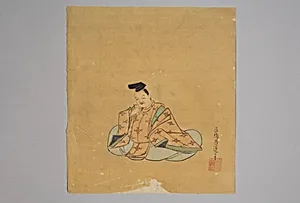
Immortal Poet
17th century
Medium
Unmounted shikisi leaf; ink and color on silk
Dimensions
7 1/4 × 6 1/2 in. (18.4 × 16.5 cm)
Classification
Paintings
Culture & Period
Japan · Edo period (1615–1868)
Department
Asian Art
Museum
Metropolitan Museum of Art, New York, NY
Credit
Gift of Estate of Samuel Isham, 1914
Accession Number
14.140.22
Rights
Public Domain
Tags
Art Historical Context
Discover the enchanting *Immortal Poet* by Shōun, a 17th-century work from Japan's Edo period (16151868). Created by an artist from the esteemed Kano school—one of Japan's most influential painting lineages known for its bold, decorative style blending Chinese ink techniques with vibrant colors—this intimate painting captures a revered male poet, evoking timeless themes of literary immortality and spiritual transcendence. The Edo era, a time of relative peace under the Tokugawa shogunate, saw a flourishing of arts patronized by samurai elites, making pieces like this cherished treasures in private collections. Rendered in ink and color on an unmounted shikishi leaf—a traditional square silk format originally used for poetry—this diminutive artwork (just 7¼ × 6½ inches) highlights the precision and elegance of Japanese fan or album painting traditions. Shikishi, prized for their poetic associations, allowed artists like Shōun to showcase refined brushwork on luxurious silk, where subtle gradations of color and fluid ink lines bring the poet's contemplative presence to life. Its small scale invites close viewing, revealing the Kano school's signature dynamism in figure depiction. Housed in the Metropolitan Museum of Art's Asian Art Department, this gift from the Estate of Samuel Isham in 1914 offers a window into Edo Japan's cultural reverence for poets as near-divine figures. Whether inspired by historical Chinese literati or Japanese ideals, *Immortal Poet* celebrates the enduring power of words and imagination.
About the Artist
Kano Shōun (Japanese) · 1637 –1702
1637–1702