
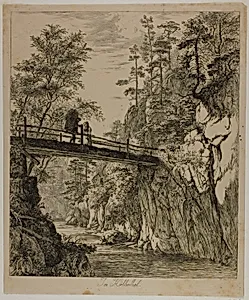
In Höllenthal
c. 1818
Medium
Etching on tan wove paper
Dimensions
33.6 × 27.8 cm (13 1/4 × 11 in.)
Classification
etching
Department
Prints and Drawings
Museum
Art Institute of Chicago
Accession Number
148275
Rights
Public Domain
Art Historical Context
**In Höllenthal**, an evocative etching by Johann Christoph Erhard from around 1818, captures the dramatic beauty of a rugged valley—likely inspired by the steep, forested gorges of Germany's Franconian Switzerland, known as Höllenthal or "Hell Valley." Erhard, a skilled German printmaker active in the early 19th century, was renowned for his precise yet atmospheric depictions of alpine and local landscapes, bridging Enlightenment topography with emerging Romantic sensibilities. This work, measuring 33.6 × 27.8 cm, invites viewers into a world of shadowed cliffs and winding paths, evoking nature's sublime power. Printed on tan wove paper, the etching exemplifies Erhard's mastery of intaglio techniques. He drew directly onto a copper plate with a needle, allowing acid to etch fine lines that hold ink, producing rich tonal contrasts and intricate details unachievable in painting. Wove paper, with its smooth, uniform texture, enhanced the subtlety of these effects, making prints like this accessible alternatives to costly originals during the Napoleonic era's economic shifts. Housed in the Art Institute of Chicago's Prints and Drawings Department, **In Höllenthal** highlights etching's role in democratizing art. Erhard's topographic accuracy and moody atmosphere reflect a cultural fascination with Germany's wild terrains, offering museum visitors a window into 19th-century wanderlust and the era's printmaking revolution. (198 words)
About the Artist
Johann Christoph Erhard · 1795–1822
Johann Christoph Erhard (1795–1822) was a German painter and etcher of the Romantic era whose sensitive landscape studies and skillful prints earned him a growing reputation before his tragically early death at twenty-six. Born in Nuremberg, he studied at the Nuremberg Academy and later in Munich, where he was influenced by the Romantic landscape tradition and the revival of interest in the art of...