
"In Piazza"
ca. 1791
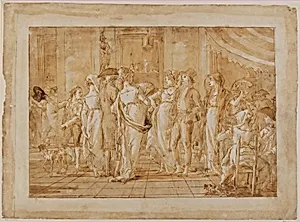
Medium
Pen and brown ink, brown wash, over black chalk
Dimensions
14 7/16 x 19 11/16 in. (36.6 x 50 cm)
Classification
Drawings
Department
Robert Lehman Collection
Museum
Metropolitan Museum of Art, New York, NY
Credit
Robert Lehman Collection, 1975
Accession Number
1975.1.510
Rights
Public Domain
Tags
Art Historical Context
Giovanni Domenico Tiepolo's "In Piazza," created around 1791, captures vibrant bustle of an Italian public square in a masterful drawing executed with pen and brown ink, brown wash black chalk. As the son of the renowned Venetian master Giovanni Battista Tiepolo Domenico inherited and refined his father's Rococo flair for dynamic compositions and fluid lines. This late work, measuring 14 7/16 x 19 11/16 inches, exemplifies the Tiepolo family's expertise in preparatory sketches that often stood alone as finished artworks, blending precise underdrawing with expressive washes to evoke light, shadow, and movement. The scene teems with everyday life—men, women, and dogs mingling amid architectural grandeur—reflecting Venice's enduring social pulse in the waning years of the Republic. Domenico's technique, with its loose, energetic strokes and subtle tonal modeling, conveys spontaneity and joy, hallmarks of 18th-century Venetian draftsmanship. Such drawings were prized by collectors for their immediacy, bridging the gap between sketch and painting. Housed in the Robert Lehman Collection at The Metropolitan Museum of Art since 1975, "In Piazza" offers a window into Domenico's mature style after his time in Spain, preserving the Tiepolo legacy of theatrical, light-filled scenes that celebrate humanity's lively spirit.
About the Artist
Giovanni Domenico Tiepolo · 1727–1804
Giovanni Domenico Tiepolo (1727-1804) was a Venetian painter, printmaker, and draftsman whose career spanned the twilight of the Rococo era. Born on August 30, 1727, in Venice as the eldest son of the celebrated Giovanni Battista Tiepolo, he worked both in his father's shadow and as a significant independent artist who developed a distinctly earthbound and humanistic vision. Domenico's importance...