
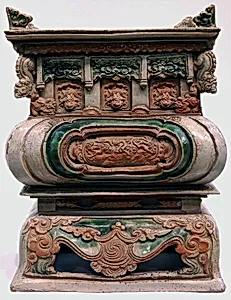
Incense burner
Unknown Artist
cyclical dated listed in donor inscription, most probably 1635
Medium
Glazed stoneware with biscuit fired molded appliqué decoration
Dimensions
H. 10 15/16 in. (27.8 cm); W. 8 7/16 in. (21.5 cm); D. 5 11/16 in. (14.5 cm)
Classification
Ceramics
Culture
Vietnam (Hai Zhong Province, Hong River delta)
Department
Asian Art
Museum
Metropolitan Museum of Art, New York, NY
Credit
Funds from various donors, in honor of Martin Lerner, 2009
Accession Number
2009.346
Rights
Public Domain
Art Historical Context
This elegant incense burner hails from Vietnam's Hai Duong Province in the Hong River delta, crafted around 1635 during the Lê dynasty's restoration period. Standing about 11 inches tall, with a width of over 8 inches and depth of nearly 6 inches, its compact form suggests it was designed for domestic altars or temple use. The cyclical date inscribed by a donor underscores its ritual purpose, evoking the spiritual life of 17th-century Vietnamese society regional kilns thriving in the fertile delta. Crafted from glazed stoneware, the burner features intricate biscuit-fired molded appliqué decoration—unglazed, matte-relief elements fired at lower temperatures and attached to the glossy glazed body. This technique highlights the potter's skill in contrasting textures and forms, possibly floral or mythical motifs symbolizing prosperity and protection. Such ceramics from the Hong River delta exemplify Vietnam's mastery of stoneware, blending Chinese influences with local innovation during a time of cultural flourishing. Acquired by the Metropolitan Museum of Art in 2009 through donor funds honoring curator Martin Lerner, this piece offers a window into Vietnam's rich ceramic heritage, where everyday objects doubled as devotional art. Visitors will appreciate its tactile allure and the whispers of ancient incense rituals it preserves.