
Independence Hall
1926
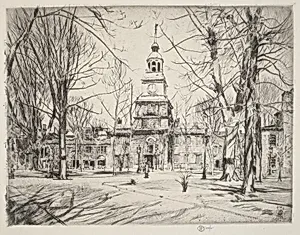
Medium
drypoint in black
Dimensions
plate: 17.15 × 22.54 cm (6 3/4 × 8 7/8 in.)
Classification
Department
CG-W
Museum
National Gallery of Art, Washington, D.C.
Credit
Gift of Miss Elisabeth Achelis
Accession Number
1942.6.46
Rights
Public Domain
Art Historical Context
Childe Hassam's *Independence Hall* (1926) captures one of America's most revered landmarks—the Philadelphia building where the Declaration of Independence signed in 1776. As a leading figure in American Impressionism, Hassam often celebrated national symbols through his luminous urban scenes and flag motifs, especially during and after World War I. drypoint print reflects his fascination with patriotic architecture, rendered with a soft, atmospheric glow that evokes the hall's enduring spirit amid early 20th-century America. Printed in black ink on a modest plate (17.15 × 22.54 cm), drypoint allowed Hassam to scratch directly into the metal surface, producing rich, velvety burrs and textured lines that mimic the play of light on stone and shadow. Unlike smoother etching techniques, drypoint's intimate, hand-worked quality suited Hassam's impressionistic style, emphasizing mood over precise detail. This edition, gifted to the National Gallery of Art by Miss Elisabeth Achelis, exemplifies his printmaking prowess in the Print department. For visitors, this work bridges Revolutionary history with modern artistry, inviting reflection on independence's timeless legacy. Spot the subtle tonal shifts that bring the iconic steeple to life— a testament to Hassam's skill in small-scale masterpieces.
About the Artist
Childe Hassam · 1859–1935
Frederick Childe Hassam, born on October 17, 1859, in Dorchester, Massachusetts, to a family of New England descent with ties to Nathaniel Hawthorne through his mother, Rosa Delia Hawthorne, displayed an early aptitude for art. After his father's cutlery business was ruined by the Great Boston Fire of 1872, Hassam apprenticed as a wood engraver under George E. Johnson while taking drawing and wate...